Three Days. One Journey.
Every Weekend Is a Golden Weekend on Free~Range Radio

FRIDAY ~ FREE FOR ALL FRIDAY
The Night the Rules Went Out the Window
Monday had its roots. Tuesday had its heartbreak. Wednesday had its revolution. Thursday had its guilty pleasures.
And now it's Friday.
Free~For~ All Friday is exactly what it sounds like. No format. No formula. No rules. No guardrails. No apologies. At any moment on a Friday you might hear Pink Floyd dissolve into Bob Marley dissolve into Guns N' Roses dissolve into Nirvana dissolve into Kansas dissolve into Bob Seger dissolve into Rage Against the Machine dissolve into Yes dissolve into The Clash dissolve into Tom Petty.
That's not chaos. That's curation.
The art of Free For All Friday is in the flow — the way one song opens the door for the next, the way a progressive rock epic can breathe into a reggae groove, the way a hair metal anthem can give way to a Midwest rock confession without either song losing a single ounce of what makes it great. The connections between all of these musics are always there if you know where to find them. And on Free~Range Radio we always know where to find them.
Because we've been tracing those connections all week long.
The only two fixed points in the entire day are sacred and non-negotiable.
4:20pm — The 4:20 Set. Forty minutes of reggae and dub and cosmic groove. Every Friday. No announcements. No explanation. No apologies. You know what time it is.
Midnight — Midnight Metal Meltdown takes the reins. And doesn't let go until dawn.
Everything else is fair game. Everything else is Friday.
But fair game doesn't mean uninformed. Fair game means the entire history of popular music is available simultaneously and the only question is which thread to pull next. So here is the education — the DNA of the Friday mix, the musical history that flows through every hour of every Free For All Friday whether you can hear it explicitly or not.
THE GRAND AMBITION ~ PROGRESSIVE ROCK
In the late 1960s something genuinely radical happened in British music. A group of musicians — most of them classically trained, all of them restless, none of them satisfied with the three chord twelve bar format that had defined rock since its birth — started asking a question that changed everything.
What if we didn't limit ourselves?
What if a rock song lasted twenty minutes? What if it told a complete story with movements and themes and musical development the way a symphony told a story? What if we brought in classical composition and jazz harmony and folk melody and ancient instrumentation and electronic experimentation and used all of it simultaneously in service of a single musical vision?
What came out of those questions was progressive rock. And it was magnificent and excessive and occasionally ridiculous and always ambitious and completely unlike anything that had existed before it.
Yes were five musicians of such extraordinary technical ability that their music existed in its own gravitational field. Close to the Edge — their 1972 masterpiece — contains three tracks. The title track alone runs eighteen minutes and forty seconds and moves through more musical ideas in those eighteen minutes than most bands explore in entire careers. Jon Anderson's voice floated above the music like something not entirely of this earth — pure and high and mystical in a way that suggested he was receiving transmissions from somewhere beyond the normal frequency range. Steve Howe's guitar combined classical technique with rock energy in ways that still sound technically impossible. Chris Squire's bass was so melodic and so prominent it functioned as a lead instrument in its own right.
Emerson Lake and Palmer took progressive rock into pure classical territory and then detonated it. Keith Emerson was a keyboard genius who rewired Moog synthesizers to do things their designers never imagined — who performed classical pieces at rock concert volumes — who literally stabbed his Hammond organ with knives during performances because he was that committed to the visceral physical experience of music. Greg Lake sang with a voice of pure cathedral beauty. Carl Palmer drummed with an orchestral precision and a physical power that made other drummers simultaneously inspired and deeply insecure.
Genesis — the Peter Gabriel era — made concept albums of such theatrical and musical complexity that their live shows required elaborate costumes and staging that Peter Gabriel designed himself. The Lamb Lies Down on Broadway is a double album telling the surrealist story of a New York street kid named Rael that makes almost no literal sense and is absolutely riveting from beginning to end.
Pink Floyd transcended progressive rock entirely and became something beyond category. The Dark Side of the Moon spent 741 weeks on the Billboard charts. Not days. Weeks. Wish You Were Here — written about their former bandmate Syd Barrett who had been destroyed by mental illness and the music industry in roughly equal measure — remains one of the most heartbreaking pieces of music ever recorded. Animals examined capitalism through the lens of George Orwell's Animal Farm. The Wall examined fame and isolation and the walls we build around ourselves with a theatrical ambition that resulted in one of the most elaborate concert productions in history.
Jethro Tull brought British folk music and — improbably magnificently — a literal flute into progressive rock and somehow made the whole enterprise heavy and urgent and completely unlike anyone else. Ian Anderson standing on one leg playing a flute is one of rock's most iconic images and the music behind the image is extraordinary.
King Crimson were the most uncompromising of all. Robert Fripp's guitar playing so angular and so technically demanding and so completely outside conventional rock that the band has never sounded like anyone else at any point in its five-decade career. In the Court of the Crimson King arrived in 1969 and sounded like the future arriving twenty years ahead of schedule.
Rush — three Canadians from Toronto who combined progressive rock's technical ambition with hard rock's physical power and Geddy Lee's extraordinary voice and Neil Peart's drumming — which was not merely the best rock drumming of its era but an entirely new conception of what a drum kit could do and what percussion could mean in a rock context. 2112. Moving Pictures. Permanent Waves. Albums that reward every single listen with something new.
Progressive rock gave Friday its ambition. Its willingness to take the long way around. Its conviction that a musical journey is worth taking even — especially — when the destination is uncertain.
THE COSMIC GROOVE ~ REGGAE AND THE 4:20 SET
At 4:20pm every Friday Free~Range Radio observes the most beloved unofficial holiday in music history.
The 4:20 Set.
Forty minutes of the most gloriously hazy deeply grooving spiritually expansive reggae and dub ever recorded. No announcements. No explanation. No apologies. Just the music. Just the groove. Just forty minutes of pure sonic liberation right in the middle of Friday afternoon.
You know what time it is.
But to understand what those forty minutes mean you have to understand where the music comes from.
Reggae grew out of Jamaica in the 1960s — itself evolved from ska and rocksteady — and it is one of the most extraordinary musical transformations in history. A music born from colonialism and poverty and oppression that became one of the most joyful and most spiritually profound musical forms on earth. That transformation from suffering to transcendence is not incidental to reggae. It is reggae. It is the entire point.
The rhythm itself is worth examining because the reggae rhythm is one of the most sophisticated and most seductive in all of popular music. The skank — that choppy guitar or keyboard chord on the offbeat, the beat that American ears are not accustomed to emphasizing — creates a feeling of perpetual forward motion that is simultaneously relaxing and energizing. The bass sits impossibly deep in the pocket. The drummer locks with the bass player so tightly they share a single pulse. The whole rhythm breathes together as a single organism.
Bob Marley is the name everyone knows. And Bob Marley deserves every syllable of his legend. He took Jamaican music and gave it a global stage and in doing so became one of the most important cultural figures of the twentieth century. But his importance goes beyond the music. Marley used music as a vehicle for a complete philosophical and spiritual vision — rooted in Rastafarian belief, focused on love and resistance and liberation and the fundamental dignity of every human being.
No Woman No Cry is not just a beautiful song. It is a document of survival — of a man singing to a woman in the government yards of Trenchtown Jamaica telling her that everything is going to be alright with a conviction born from lived experience rather than easy optimism. Redemption Song — just Marley and an acoustic guitar — is one of the great pieces of music of the twentieth century. A song about mental slavery and emancipation in language so simple and so profound it functions as scripture.
But the 4:20 Set goes deeper than Marley.
Lee "Scratch" Perry invented dub — the art of taking existing reggae recordings and stripping them apart, drowning them in reverb and echo and delay, rebuilding them as something psychedelic and disorienting and profoundly strange. Perry's Black Ark studio in Kingston Jamaica was a laboratory of sonic experimentation that produced music unlike anything that existed before or since. Dub is music that exists in the space between the notes. It is reggae dreaming about itself.
Toots and the Maytals were making music so soulful and so energetic that their live performances were events of almost religious intensity. Toots Hibbert actually coined the term reggae — his song Do the Reggay in 1968 gave the music its name. Burning Spear made roots reggae of such spiritual depth that listening to it felt like meditation. Steel Pulse brought reggae's message to Birmingham England with a political urgency rooted in the experience of being Black in Thatcher's Britain.
The influence of reggae spread everywhere and into everything. The Clash absorbed it completely — their early albums drenched in reggae and ska that gave their punk energy a rhythmic sophistication it wouldn't have had otherwise. The Police built their entire sonic identity on a reggae skeleton — Andy Summers' guitar playing shaped by dub, Stewart Copeland's drumming shaped by Caribbean rhythms, Sting's bass lines shaped by the deep pocket of Jamaican studio musicians. Sublime in the 1990s combined reggae with punk and hip hop in Long Beach California and created something that defied every category and has never stopped finding new audiences.
Forty minutes. Every Friday at 4:20. The groove at the center of the day.
THE ARENA ERUPTS ~ HAIR METAL
After the groove something happens.
The temperature in the room changes.
The guitars get louder.
Hair metal — also called glam metal — was the sound of the 1980s turned up to eleven and dipped in hairspray and leather and spandex and absolutely zero artistic pretension and it was GLORIOUS.
The critics hated it. The rock purists hated it. The punk rockers who had spent the previous decade tearing down the rock establishment really hated it. And hair metal did not care about any of that because hair metal was too busy selling out arenas and making videos for MTV and having the most fun that anyone had ever had with a guitar.
Van Halen started it. Eddie Van Halen's guitar playing was so technically innovative and so jaw-droppingly exciting that it genuinely changed what rock guitar sounded like almost overnight. Eruption — the solo from their 1978 debut album — is one man rewriting the rules of what is physically possible on a six-string electric guitar in one minute and forty-two seconds. Two-handed tapping. Hammer-ons and pull-offs at speeds that seemed mechanically impossible. A tone so warm and so singing that the guitar sounded almost like a human voice.
David Lee Roth was the greatest frontman of his generation — all gymnastic energy and outrageous humor and genuine charisma that leaped off the stage and hit you in the chest from the back row of an arena. He made everything look effortless and nothing was. Jump. Panama. Hot for Teacher. Running With the Devil. Van Halen made it look fun because it was fun and they never let you forget it.
Motley Crue were four kids from Los Angeles who should not have survived the 1980s and somehow did. Their autobiography The Dirt is so excessive and so outrageous that it reads like fiction. But the music was tighter and more disciplined than their reputation suggested. Dr. Feelgood. Kickstart My Heart — a song built around Tommy Lee's drumming which was genuinely innovative, genuinely physical, genuinely exciting in ways that the band's tabloid reputation consistently overshadowed.
Def Leppard brought a melodic sophistication to arena rock that elevated the entire genre. Producer Mutt Lange pushed them toward vocal harmonies stacked so high and hooks so precisely engineered that Hysteria sold twenty million copies and deserved every single one. The story of Rick Allen — losing his arm in a New Year's Eve car crash in 1984 and returning the following year to record one of the biggest albums of the decade on a custom electronic kit — is not a rock story. It is a human story about refusal and courage and the absolute necessity of music to people who need it the way they need oxygen.
Guns N' Roses arrived in 1987 with Appetite for Destruction and changed everything. Axl Rose was genuinely dangerous in a way that most rock stars only pretended to be. Slash was the real thing — a guitarist who combined Delta blues feeling with hard rock power in a combination so natural it sounded inevitable. Welcome to the Jungle. Sweet Child O' Mine. Paradise City. Mr. Brownstone. These are not hair metal songs. These are simply great rock songs that happened to arrive during the hair metal era.
Skid Row. Warrant. Whitesnake. Ratt. Poison. Cinderella. Tesla — who were actually a serious band making serious music that got lumped into glam metal because of the era they existed in. Each making music designed to make you have a good time without apology. Hair metal understood something fundamental about Friday evening. It understood that sometimes the most important thing music can do is give you permission to stop being serious.
THE HEARTLAND SPEAKS ~ MIDWEST ROCK
As the arena energy crests and begins to settle into something more personal and more honest Midwest rock arrives.
The sound of wide open spaces and working class lives and long empty highways and Friday nights in small towns where the best thing you could do was drive and listen to the radio and feel the particular American feeling of being simultaneously free and trapped and grateful and restless all at once.
Bob Seger was Detroit and proud of every inch of it. Night Moves is one of the great American songs — a perfect evocation of teenage summers in Michigan, of the specific bittersweet ache of looking back at who you were with full knowledge of who you became. Against the Wind captured something universal about the gradual accumulation of life's compromises with a melodic grace that made the sadness feel like wisdom. Turn the Page — recorded live with an unforgettable saxophone intro — is so honest about the loneliness of life on the road that every musician who has ever driven through the night to a show in a town they'd never heard of has claimed it as their own.
Tom Petty was Gainesville Florida by birth but American highway rock by nature. He wrote songs with the melodic economy of the best pop songwriters and the raw energy of the best rock musicians and made the combination look completely effortless for forty years. I Won't Back Down is not just a rock song. It is a philosophy. Free Fallin' is not just a California song — it is a song about freedom and guilt and the complicated geography of the American dream. American Girl. Running Down a Dream. Refugee. Even the name of his band told you exactly where the music was coming from.
John Mellencamp was singing about Jack and Diane and small town America and the farms being foreclosed and the factory jobs disappearing with a directness that felt less like songwriting and more like bearing witness. Pink Houses asked whether the American dream was available to the people it was supposedly promised to — and answered its own question with an honesty that made radio programmers nervous and listeners feel seen. He was Bruce Springsteen's Midwestern cousin — less mythological, more specific, equally essential to understanding what America actually sounds like from the inside.
REO Speedwagon. Styx. Kansas. Cheap Trick. Each band making music that was rooted in the same soil as the blues and country that started the Musical Evolution Week — the same American heartland, the same working lives, the same fundamental decency and the same frustrated longing for something bigger and freer than the life immediately available. Midwest rock plugged in. Turned up. And drove. And in driving honest and driving hard created music that has outlasted almost everything that was considered more sophisticated at the time.
THE LAST GREAT REVOLUTION ~ 90s ALTERNATIVE
On September 24, 1991, Nirvana released Nevermind.
The lead single Smells Like Teen Spirit went on MTV and within weeks everything sounded different. Kurt Cobain had somehow combined the melody of the Beatles with the noise of punk and the dynamics of the Pixies into songs so perfectly constructed and so viscerally powerful that they made the previous decade of rock radio sound suddenly irrelevant.
But to understand what Nirvana did you have to understand what came before them in the underground.
The Pixies had been making quiet-loud-quiet music since 1986 — Frank Black's surrealist lyrics delivered in a voice that moved from a whisper to a scream with terrifying speed, Kim Deal's bass playing deceptively simple and completely essential, Joey Santiago's guitar playing angular and strange and melodically beautiful all at once. Kurt Cobain himself said that in writing Smells Like Teen Spirit he was trying to write the ultimate Pixies song. The Pixies never got the commercial recognition they deserved in real time. Alternative rock spent the entire 1990s cashing the check the Pixies wrote.
Sonic Youth had been combining avant-garde noise experimentation with pop songwriting instincts since the early 1980s — Thurston Moore and Lee Ranaldo and Kim Gordon retuning their guitars to custom open tunings and creating sonic textures that had no precedent in rock music. They were the art school credibility at the center of the alternative universe — the band that every other band wanted to impress.
R.E.M. had been building toward the alternative moment from Athens Georgia since 1980. Michael Stipe's oblique poetic lyrics. Peter Buck's chiming Byrds-influenced guitar. The rhythm section's locked-in precision. Losing My Religion — written on a mandolin, built into one of the most recognizable songs of the decade. Everybody Hurts — so direct and so unguarded in its compassion that it saved lives. These are not alternative rock songs. These are simply great songs.
Pearl Jam. Eddie Vedder's voice an instrument of almost frightening emotional power. Alive. Even Flow. Jeremy. Black. Songs that felt less composed than confessed.
Soundgarden. Chris Cornell's voice capable of ranges that seemed physically impossible. Black Hole Sun. Spoonman. Like Suicide. The Day I Tried to Live. Superunknown is one of the great albums of the decade — heavy and melodic and dark and beautiful and completely uncompromising.
Alice in Chains brought genuine darkness. Layne Staley's voice a thing of terrible beauty — the harmonies between him and Jerry Cantrell some of the most distinctive and most haunting in rock history. Would. Rooster. Down in a Hole. Their MTV Unplugged performance is one of the most emotionally devastating things ever broadcast on television.
The Smashing Pumpkins were making albums of such sonic ambition and such emotional scale that they seemed perversely out of step with the stripped-down grunge ethos. Siamese Dream. Mellon Collie and the Infinite Sadness. Today. Bullet With Butterfly Wings. 1979. Music that sounded like it was trying to contain everything that had ever been felt by everyone who had ever felt anything.
Green Day took the Ramones blueprint and added Billy Corgan's melodic sophistication and made punk not just acceptable but enormously commercially successful without losing any of its energy or attitude. Dookie in 1994. Basket Case. Longview. When I Come Around. Songs that captured the specific restlessness of being young and not yet knowing what your life was going to be.
Weezer. The Blue Album. Twelve songs of such perfect melodic construction and such endearing nerdy sincerity that it stands as one of the great power pop albums in history. Buddy Holly. Say It Ain't So. Undone. Rivers Cuomo writing confessional songs about being a misfit with hooks so sharp they could draw blood.
Beck. Loser. Where It's At. Devil's Haircut. Odelay in 1996 one of the most genuinely original albums of the decade — part hip hop part folk part alternative rock part pure surrealist adventure.
Rage Against the Machine making political statements with such musical force that they functioned simultaneously as protest art and physical experience. Tom Morello's guitar playing so innovative — using the instrument as a turntable, as a synthesizer, as a noise machine — that he created an entirely new vocabulary for the electric guitar.
The Replacements — who were making the greatest American rock records of the 1980s to almost nobody's attention and broke up just as the world was finally ready to hear them. Pavement. Guided by Voices. Built to Spill. Dinosaur Jr. Sebadoh. Yo La Tengo. The artists in the underground who made the mainstream possible and never got the credit for it.
THE CONNECTIONS NOBODY TALKS ABOUT
Here is what Friday teaches you if you listen carefully enough.
Progressive rock and reggae are not opposites. They are both music that refuses to be rushed — music that takes its time, that breathes, that creates space for something to happen rather than filling every second with noise. Yes and Bob Marley both understood that silence is part of the music.
Hair metal and Midwest rock are not opposites either. They are both music about longing — about wanting something bigger and freer than your current circumstances. Van Halen and Bob Seger are both singing about the same Friday night feeling from different zip codes.
And 90s alternative? 90s alternative is what happens when the children of all of the above — raised on progressive rock and reggae and hair metal and Midwest rock and punk and new wave and everything the week has already covered — pick up instruments and process everything they've heard and turn it into something new.
Every Friday on Free~Range Radio you are hearing a hundred years of music in conversation with itself. That conversation has no agenda and no destination and no rules.
It just has the music.
And the music always knows where it wants to go.
The only fixed points are sacred.
4:20pm — The 4:20 Set. You know what time it is.
Midnight — The clock strikes twelve. Midnight Metal Meltdown takes the reins.
And Free For All Friday becomes something that doesn't stop until dawn.
Free~Range Radio ~ Beyond Sonic Borders 1-877-33VINYL
🎙️
MIDNIGHT METAL MELTDOWN
When the Clock Strikes Twelve — There Is No Going Back
The witching hour belongs to the riff.
Every Friday at midnight Free~Range Radio unleashes its darkest hour. The week has been building to this moment — the blues and the country and the rebellion and the pop and the progressive ambition and the alternative fury — all of it converging at the midnight hour into the heaviest most uncompromising most viscerally powerful music that the twentieth century produced.
Midnight Metal Meltdown is not for the faint of heart.
It is however for anyone who has ever felt the floor shake from a bass cabinet. Anyone who has ever stood in the pit and felt the music not just in their ears but in their chest and their bones and somewhere deeper than bones. Anyone who has ever understood that volume is not just quantity but quality — that there is a frequency of loudness where music stops being something you listen to and becomes something you survive.
Those people know what midnight is for.
WHERE IT CAME FROM ~ THE ROOTS OF METAL
Heavy metal did not arrive fully formed. It evolved. And like everything on Free~Range Radio it evolved from everything that came before it.
The blues gave metal its soul. The bent note. The minor key. The feeling of darkness and longing and something dangerous lurking underneath the music. Robert Johnson sold his soul at the crossroads and heavy metal has been cashing that transaction ever since. When Tony Iommi plays a riff in a minor key he is channeling something that started in the Mississippi Delta a century ago — filtered through amplifiers and distortion pedals and turned up to volumes that Robert Johnson never imagined but would almost certainly have approved of.
Rockabilly gave metal its attitude. The swagger. The leather jacket. The sneer. Eddie Cochran and Gene Vincent were playing with an aggression and a physical energy that pointed directly toward what was coming. They just didn't have the Marshall stacks yet.
The British Invasion gave metal its ambition. When the Rolling Stones and the Yardbirds took American blues and cranked up the volume and the aggression in London in the mid 1960s they created the template that every heavy rock band since has built on. Keith Richards' guitar tone on Satisfaction — that fuzztone riff that announced itself like a declaration of war — was the first step on the road to metal.
And then three bands arrived within two years of each other and changed everything permanently.
THE HOLY TRINITY ~ THE BANDS THAT INVENTED HEAVY METAL
On February 13 1970 Black Sabbath released their debut album.
That date matters. That album matters. That day is as significant to heavy metal as the day Elvis walked into Sun Studio is to rock and roll. Because Black Sabbath did not merely make a heavy rock record. They invented a genre.
Four working class kids from Birmingham England — Tony Iommi, Geezer Butler, Ozzy Osbourne, and Bill Ward — created music so dark and so heavy and so unlike anything that existed before it that the music industry literally did not know what to do with it. The opening of the first Black Sabbath album — rain falling, a church bell tolling, a tritone riff descending like something from the bottom of a very dark well — announced that something genuinely new had arrived. The tritone was called diabolus in musica by medieval musicians — the devil in music — and the Catholic Church banned it for centuries because it sounded evil. Tony Iommi used it as a foundation for an entire musical philosophy.
Tony Iommi lost the tips of two fingers on his right hand — his fretting hand — in an industrial accident at a sheet metal factory when he was seventeen years old. The doctors told him he would never play guitar again. He fashioned thimble-like prosthetics from melted plastic, tuned his guitar down to reduce string tension, and invented the heavy metal guitar sound almost entirely by accident. The downtuned guitar — the thick slow massive riff — is the sound of a man playing around a disability and in doing so creating something that ten thousand guitarists spent the next fifty years imitating.
Geezer Butler wrote the lyrics — and the lyrics mattered. War. Nuclear destruction. The occult. Death. The darkness of industrial England. The nightmares that the postwar boom had failed to banish. Black Sabbath looked at the flower power and peace and love of the late 1960s and said — respectfully — that is not the whole story. The whole story includes this. And this is dark.
Led Zeppelin arrived the same year from London. Jimmy Page had been in the Yardbirds. Robert Plant had been singing in obscure Midlands bands. John Paul Jones was one of the most in-demand session musicians in London. John Bonham was a drummer from Redditch who hit the drums as if they had personally offended him.
Together they created music that was simultaneously blues and folk and psychedelia and hard rock and orchestral rock — music of such dynamic range that it could move from a whisper to a roar within a single song and make both feel inevitable. Whole Lotta Love. Kashmir. When the Levee Breaks — John Bonham's drums recorded in a stairwell at Headley Grange with microphones placed on different levels to capture the natural reverb of the space, creating a drum sound so massive and so distinctive that it has never been equaled. Black Dog. Immigrant Song. Communication Breakdown.
Led Zeppelin were technically not heavy metal — they were too diverse, too folk-influenced, too blues-rooted to fit neatly into any single category. But they gave heavy metal its mythology. Its grandiosity. Its conviction that rock music could be epic and ancient and physically overwhelming all at once.
Deep Purple completed the trinity. Machine Head — released in 1972 — contains Smoke on the Water whose opening riff is perhaps the most recognizable guitar riff in rock history. Ritchie Blackmore's guitar playing combined classical technique with hard rock aggression in a way that influenced virtually every metal guitarist who came after him. Jon Lord's Hammond organ — run through a Marshall stack to distort it — was a sonic innovation that created a whole new sound for keyboards in a rock context. Ian Gillan's voice could reach registers that seemed physically impossible and sustain them with a power and a control that made other vocalists feel inadequate.
These three bands — Black Sabbath, Led Zeppelin, Deep Purple — are the foundation. Everything else is built on what they built.
THE FIRST WAVE ~ METAL GROWS UP
Through the 1970s heavy metal developed its own identity and its own audience — an audience that was largely ignored by the music press and the mainstream but was enormous and devoted and growing.
Judas Priest arrived from Birmingham — the same city as Black Sabbath, which is not a coincidence — and codified the visual language of metal. The leather and studs and chains that became the genre's uniform. Rob Halford's voice an instrument of extraordinary range and power — capable of glass-shattering high notes sustained with a precision that seemed impossible for a human voice. The twin guitar attack of Glenn Tipton and K.K. Downing creating a sound that was tighter and more precise than Black Sabbath's doom-laden approach. British Steel. Screaming for Vengeance. Defenders of the Faith. Albums that defined an era.
Motorhead arrived with Lemmy Kilmister — a man who seemed to exist outside of normal biological rules — playing bass like a rhythm guitarist and barking lyrics about war and speed and excess in a voice that sounded like gravel being fed through a garbage disposal. Motorhead were too fast and too loud for heavy metal and too heavy for punk and they occupied that no man's land between the two genres with complete contentment. Ace of Spades is the greatest rock and roll song about fatalism ever recorded. Lemmy died at seventy years old with a glass of Jack Daniel's in his hand and his ashes were loaded into bullets and fired by his friends and that is the most Lemmy thing that has ever happened.
Rainbow. Uriah Heep. Thin Lizzy — whose twin lead guitar attack inspired every dual guitar band that followed and whose frontman Phil Lynott was the first Black rock star to lead a major hard rock band. UFO. Status Quo. Saxon. The first generation of metal was building a world.
THE NEW WAVE OF BRITISH HEAVY METAL ~ THE FIRE GETS HOTTER
At the end of the 1970s just as punk was burning itself out a new generation of British metal bands arrived that took everything the first wave had built and made it faster and heavier and more aggressive.
The New Wave of British Heavy Metal — NWOBHM to its devotees — was a grassroots movement that grew out of the same working class British towns that produced punk. But where punk had stripped rock down to its skeleton the NWOBHM built it back up — keeping the energy and the aggression and adding back the musicianship and the ambition.
Iron Maiden arrived from East London with Steve Harris's bass-driven compositions and a visual mythology built around their mascot Eddie — a rotting corpse who appeared on every album cover in a different guise. Paul Di'Anno sang on the first two albums with a punk-influenced rawness. Then Bruce Dickinson arrived and everything changed. The Air Raid Siren — a voice of such power and range and theatrical precision that it could fill an arena without a microphone. The Number of the Beast. Piece of Mind. Powerslave. Somewhere in Time. Iron Maiden built one of the most devoted fan bases in rock history — a global community united by the twin pleasures of the music and the mythology.
Def Leppard straddled the line between NWOBHM and the commercial arena rock that would become hair metal — taking the energy and the twin guitar attack of the movement and applying a melodic sensibility and a production gloss that made them enormous and made purists uneasy in roughly equal measure.
Diamond Head. Angel Witch. Venom — who were so extreme and so deliberately provocative that they essentially invented the template for black metal a decade before black metal existed.
And Metallica were listening to all of it.
THE AMERICAN INVASION ~ THRASH METAL AND THE SPEED WARS
In the early 1980s something happened in the garages and rehearsal spaces of the American suburbs that took the NWOBHM template and set it on fire.
Thrash metal.
Faster. Heavier. More aggressive. More technically demanding. Music that operated at tempos that seemed physically unsustainable and sustained them for entire albums without flagging.
Metallica formed in Los Angeles in 1981 — James Hetfield and Lars Ulrich finding each other through a classified ad, adding lead guitarist Dave Mustaine, then replacing Mustaine with Kirk Hammett and adding Cliff Burton on bass. Kill 'Em All in 1983. Ride the Lightning in 1984. Master of Puppets in 1986 — an album so complete and so devastating in its heaviness and its musical ambition that it is frequently cited as the greatest metal album ever made. The title track is a nine minute exploration of addiction and control that builds and releases tension with a compositional sophistication that would be impressive in any genre.
Then Cliff Burton died — killed when the tour bus crashed on a Swedish highway on September 27 1986 — and Metallica became something different. Still great. Still important. But the loss of Burton's musical vision and his melodic bass playing left a hole that was never quite filled.
Megadeth were founded by Dave Mustaine after his dismissal from Metallica — a founding carried out with such bitterness and such determination to prove something that Mustaine channeled it into a career of extraordinary technical ambition. Peace Sells. Rust in Peace — an album of such technical complexity and musical density that it stands as one of the great achievements in metal history.
Slayer were different from all of the above. Where Metallica had melody and compositional sophistication and Megadeth had technical virtuosity Slayer had pure aggression — songs of relentless speed and deliberate darkness that pushed metal into territory that made even other metal musicians uncomfortable. Reign in Blood — released in 1986 and clocking in at twenty-eight minutes — is the most extreme mainstream metal album ever recorded. Tom Araya screaming over Kerry King and Jeff Hanneman's guitar assault and Dave Lombardo's drumming — which was so fast and so precise that it redefined what was physically possible behind a drum kit.
Anthrax brought humor and hip hop influence and New York energy into thrash metal — collaborating with Public Enemy on a version of Bring the Noise that proved the connection between metal and hip hop that nobody in either genre wanted to admit.
The Big Four — Metallica, Megadeth, Slayer, Anthrax — defined American thrash metal. But beneath them a second tier was developing that pushed things even further.
Testament. Exodus — whose guitarist Gary Holt wrote Bonded by Blood before Slayer recorded Reign in Blood and whose influence on thrash is immeasurable. Death Angel. Overkill. Sepultura from Brazil bringing South American fury to the genre. Kreator and Destruction and Sodom from Germany creating a European thrash scene of extraordinary ferocity.
THE UNDERGROUND GETS DARKER ~ DEATH METAL AND BLACK METAL
In the late 1980s a segment of the metal community decided that thrash was not extreme enough. They went underground. Literally — rehearsing in basements and pressing their records in small quantities and trading cassette tapes through the mail in a proto-internet network of extreme music devotees.
What emerged from that underground was death metal.
Death metal took thrash's speed and aggression and added down-tuned guitars of almost subsonic heaviness, drumming of mechanical precision at inhuman tempos — the blast beat, a technique where the drummer alternates the bass drum and snare so rapidly that the individual hits blur into a continuous roar — and vocals delivered not as singing but as a guttural growl that sounded less like a human voice and more like a force of nature.
Chuck Schuldiner of Death is the father of the genre. His band's evolution from the raw brutality of Scream Bloody Gore in 1987 to the progressive sophistication of Individual Thought Patterns in 1993 is one of the most extraordinary artistic trajectories in metal history. He died of brain cancer in 2001 at thirty-four years old — a devastating loss to music.
Possessed. Morbid Angel. Obituary. Cannibal Corpse. Deicide. Each band pushing the extremity further — the music becoming progressively heavier, faster, darker, more technically demanding, more deliberately confrontational.
Black metal arrived from Norway in the early 1990s and it was genuinely alarming in ways that went beyond the music. Mayhem. Burzum. Darkthrone. Emperor. Bands making music of extreme coldness and hatred and nihilism — thin trebly guitars playing tremolo-picked riffs over blast-beat drumming and shrieked vocals about winter and death and darkness. Several members of the Norwegian black metal scene burned down medieval churches and at least one committed murder. The music was made in a context of actual violence and actual criminality that gave it a darkness that was not theatrical.
But underneath the criminality was genuine musical innovation. The production aesthetic of black metal — raw and cold and deliberately lo-fi — was a reaction against the polished production of mainstream metal. The compositional approach — long atmospheric pieces that built slowly and paid off in waves of sound — pointed toward something genuinely new.
THE AMERICAN ALTERNATIVE ~ GROOVE METAL AND THE METAL THAT CROSSED OVER
While the underground was getting darker the American mainstream was developing its own strain of heavy music.
Pantera from Arlington Texas transformed themselves from a glam metal band into something completely different — Phil Anselmo's aggressive vocals and Dimebag Darrell's extraordinary guitar playing and Vinnie Paul's thunderous drumming creating a groove-based heaviness that was unlike anything in metal at the time. Cowboys from Hell in 1990. Vulgar Display of Power in 1992. The Great Southern Trendkill. Dimebag Darrell was killed on stage in Columbus Ohio in December 2004 — shot by a deranged fan while performing with his new band Damageplan. He was thirty-eight years old. The guitar world went into mourning.
White Zombie. Rob Zombie's cinematic vision combining horror movie imagery with industrial-influenced metal and hip hop samples to create something that was simultaneously heavy and danceable and completely its own thing. La Sexorcisto: Devil Music Vol. 1 was one of the most viscerally exciting metal records of the early 1990s.
Soundgarden and Alice in Chains brought metal DNA into the alternative rock mainstream — proving that the heaviness of metal and the emotional intelligence of alternative rock were not incompatible. Chris Cornell's voice. Layne Staley's voice. Two of the great tragic figures of 1990s music — both lost to the same darkness they sang about.
Tool arrived in 1993 and were immediately something apart from everything else in metal. Maynard James Keenan's vocals shifting between whispered intimacy and full-throated power. Adam Jones's guitar playing melodic and heavy simultaneously in a combination that seemed contradictory until you heard it. Danny Carey's drumming incorporating polyrhythmic complexity that drew on jazz and world music as much as metal. Undertow. Aenima. Lateralus — built around the Fibonacci sequence, the mathematical ratio that appears throughout nature, embedded in the time signatures and the lyrics with a conceptual ambition that made progressive rock fans pay attention.
WHERE METAL IS GOING
Metal never stopped evolving. Never stopped absorbing influences from outside itself. Never stopped splitting into new subgenres and cross-pollinating with adjacent music.
Nu-metal arrived in the late 1990s — Korn, Limp Bizkit, System of a Down — bringing hip hop and alternative and industrial influences into a heavier context. Divisive then. Influential now. System of a Down in particular — Armenian-American musicians from Los Angeles processing genocide and diaspora and American politics through a musical lens that combined metal with folk music from the Caucasus and pop melody and pure surrealism — made music of genuine political and emotional complexity.
Progressive metal deepened the dialogue between metal and progressive rock. Dream Theater — technically among the most accomplished musicians in any genre, making albums of such compositional complexity that they require multiple listens before they fully reveal themselves. Opeth from Sweden moving fluidly between brutal death metal and delicate acoustic folk within single songs with a seamlessness that seemed impossible.
Post-metal arrived — bands like Isis and Neurosis and Pelican making long slow atmospheric instrumental pieces that owed as much to ambient music and post-rock as to metal. Music that prioritized texture and atmosphere over riffs and aggression. Metal that required patience and rewarded it.
Djent — a subgenre built around the percussive chunky downtuned palm-muted guitar sound that its name imitates — brought technical precision and odd time signatures into a context that was accessible without being simple. Meshuggah from Sweden the progenitors. Periphery and Animals as Leaders the next generation.
And through all of it — through every split and evolution and subgenre explosion — the core of what Black Sabbath created in Birmingham in 1970 remains at the center. The heavy riff. The minor key. The volume. The darkness that is not nihilism but catharsis — the understanding that sometimes the most honest response to the weight of being alive is to turn the amplifier all the way up and let the sound do what words cannot.
WHY MIDNIGHT METAL MELTDOWN EXISTS
Because metal is the most misunderstood music in popular history.
It is dismissed as noise by people who have never listened. It is written off as adolescent by people who stopped paying attention after the first album they heard. It is reduced to its most extreme and most provocative elements by critics who prefer the easy dismissal to the more demanding engagement.
But metal is also the music that has given more people more comfort in their darkest hours than perhaps any other genre. The metal community — louder and more devoted and more genuinely inclusive than its surface presentation suggests — has always been a place where outsiders find each other. Where the people who don't fit anywhere else find a home.
Metal is the music of the midnight hour because metal has always understood the midnight hour. The darkness. The weight. The feeling at the end of a long week that the world is heavy and complicated and sometimes genuinely frightening.
And metal says — yes. It is. Now turn it up.
Every Friday at midnight Free~Range Radio turns it up.
The witching hour belongs to the riff.
Free~Range Radio — Beyond Sonic Borders 1-877-33VINYL
🎙️
SATURDAY ~ PSYCHEDELIC SATURDAY
The Longest Ride of the Week
Close your eyes.
Not yet. Read this first. Then close your eyes.
Because Saturday on Free~Range Radio is not background music. Saturday is not something you put on while you do other things. Saturday is not ambient. Saturday is not casual.
Saturday is a journey. A deliberate fully committed wide-eyed trust-the-music journey through the most mind-expanding soul-stretching reality-bending music that the twentieth century produced.
And the twentieth century produced a lot of reality-bending music.
Saturday is where Free~Range Radio earns its name. Free~Range. Uncontained. Roaming. Following the music wherever it leads regardless of how far from the familiar shore it takes you. Saturday has no destination. Saturday has only direction — forward, deeper, further, and always toward the sound.
But to understand where Saturday goes you have to understand where it came from. And where it came from is a story that starts in the most unlikely of places.
A washboard. A tea chest bass. A cheap acoustic guitar. And a group of British teenagers in the early 1950s who heard American music on the radio and decided they needed to play it themselves immediately regardless of whether they knew how.
THE SEED ~ SKIFFLE AND THE BRITISH AWAKENING
Before the British Invasion invaded anything it had to be born. And it was born in the most gloriously ramshackle way imaginable.
Skiffle.
If you are an American reading this word you are probably unfamiliar with it. That is because skiffle was a British phenomenon — a homemade folk and blues hybrid that swept through the United Kingdom in the mid 1950s with a speed and a totality that can only be compared to what punk did twenty years later.
The man responsible was Lonnie Donegan. In 1954 Donegan was playing banjo in Ken Colyer's jazz band and during the intermissions the band would play a rougher more energetic style based on American jug band music and blues and folk — music that could be played on cheap instruments or improvised instruments. A washboard played with thimbles. A tea chest with a broom handle and a string for a bass. A cheap acoustic guitar.
Donegan's version of Lead Belly's Rock Island Line became a hit in 1956 and within months every teenager in Britain with access to a washboard and a desire to be in a band was playing skiffle. It was the punk rock of its era — democratic and cheap and immediate and completely accessible to anyone with enough enthusiasm to compensate for what they lacked in technical skill.
John Lennon formed a skiffle group called the Quarrymen in 1956. He was sixteen years old. On July 6 1957 at a garden fete in Woolton Liverpool the Quarrymen performed and a fifteen year old named Paul McCartney watched them play. After the show McCartney was introduced to Lennon backstage and demonstrated that he knew the chords to Twenty Flight Rock by Eddie Cochran. Lennon was impressed enough to invite him to join the group.
That meeting — between a sixteen year old skiffle player and a fifteen year old who knew an Eddie Cochran song — is the moment the modern world began.
Because the Quarrymen became the Beatles. And the Beatles became everything.
But before the Beatles there was something else. Something that connected the skiffle craze to the rock and roll that was coming across the Atlantic and the blues that was already embedded in British musical culture.
THE BRITISH BLUES OBSESSION ~ THE SOUND THAT CHANGED EVERYTHING
While American rock and roll was getting safer and more polished in the late 1950s — Pat Boone covering Little Richard, the payola scandals cleaning up rock radio, Elvis going into the Army — a group of young British musicians were going in the opposite direction.
They were digging deeper into American blues. Not the sanitized pop versions. The original recordings. Robert Johnson on scratchy 78rpm records. Muddy Waters. Howlin' Wolf. Sonny Boy Williamson. Bought in specialist record shops. Traded between obsessives. Studied with the intensity of religious texts.
Alexis Korner and Cyril Davies formed Blues Incorporated in 1961 — the first British electric blues band — and their residency at the Ealing Club in London became the seedbed for virtually everything that followed. The Rolling Stones passed through. Jack Bruce passed through. Ginger Baker passed through. Charlie Watts played drums.
John Mayall formed the Bluesbreakers and turned the band into a finishing school for British guitar talent. Eric Clapton played there. Peter Green played there. Mick Taylor played there. Each guitarist absorbing the Delta blues vocabulary and transforming it into something distinctly British.
And in Liverpool something else was happening. Something faster. Something more exuberant. Something that combined the blues obsession with the energy of American rock and roll and the melodic gift that seemed to exist in the water of Merseyside.
MERSEY BEAT ~ THE RIVER THAT CHANGED THE WORLD
Liverpool in the late 1950s and early 1960s was a port city with a direct connection to America. Sailors would come back from New York and New Orleans with American records — rock and roll and rhythm and blues and country — that hadn't been released in Britain and wouldn't be for months. Liverpool heard American music before London did.
And Liverpool responded.
The Cavern Club on Mathew Street became the center of a scene that was unlike anything elsewhere in Britain. Beat music — fast rhythmic rock and roll with strong melodies and vocal harmonies built on American rhythm and blues — was being played by hundreds of bands. The Beatles. Gerry and the Pacemakers. The Searchers. Billy J. Kramer and the Dakotas. The Merseybeats.
Brian Epstein walked into the Cavern Club in November 1961 and saw the Beatles play. He became their manager. George Martin at Parlophone agreed to sign them and immediately began the process of channeling their raw energy into recorded form. Love Me Do was released in October 1962. Please Please Me followed in January 1963 and went to number one. She Loves You in August 1963. I Want to Hold Your Hand in November 1963.
By the time I Want to Hold Your Hand was released in America in January 1964 something unprecedented was about to happen.
The British Invasion.
THE BRITISH INVASION ~ WHEN THE RIVER CROSSED THE ATLANTIC
On February 9 1964 the Beatles appeared on The Ed Sullivan Show. Seventy-three million Americans watched. That is not a television statistic. That is a cultural earthquake statistic.
The effect was immediate and total. Radio changed. Record sales changed. What it meant to be young changed. The guitar became the instrument of a generation. Hundreds of thousands of American teenagers who had never considered playing an instrument went out and bought guitars and started bands in their garages within weeks of that broadcast.
The Beatles were the spearhead but behind them came a wave.
The Rolling Stones arrived in America in 1964 with a harder blues-rooted sound that contrasted deliberately with the Beatles' relative sweetness. Brian Jones was the musical visionary — a multi-instrumentalist of extraordinary curiosity who absorbed every musical influence he encountered. Keith Richards and Brian Jones creating a guitar interplay that was rhythmically sophisticated in ways that rock guitar had never been before. Mick Jagger's sexuality and charisma providing a focal point that was simultaneously exciting and slightly threatening to the parents of America. (Not Fade Away. Time Is on My Side. The Last Time. Then in 1965 — Satisfaction. Everything changed.)
The Kinks arrived with You Really Got Me — a riff so simple and so powerful that it effectively invented hard rock. Ray Davies writing songs of such Englishness and such sharp social observation that they documented a world — postwar Britain with its class distinctions and its fading empire and its quiet desperation — that no other songwriter was examining. Dedicated Follower of Fashion. Sunny Afternoon. Waterloo Sunset — perhaps the most beautiful song ever written about London.
The Who arrived with the philosophy of Maximum R&B and Pete Townshend's windmill guitar arm and Roger Daltrey's microphone swing and Keith Moon's drumming — Keith Moon who played drums not as a timekeeper but as a lead instrument, who played every fill as if it were his last, who approached the drum kit as if it had personally offended him and needed to be taught a lesson. My Generation. Anyway Anyhow Anywhere. I Can't Explain. And then the ambition grew — Tommy. Quadrophenia. Live at Leeds — possibly the greatest live rock album ever recorded.
The Animals came from Newcastle with the voice of Eric Burdon — raw and soulful in a way that sounded less like a white British singer imitating American blues and more like genuine soul music from an unexpected source. The House of the Rising Sun — a traditional American folk song transformed by Alan Price's organ arrangement into something haunting and cinematic and completely their own.
The Yardbirds were the great guitar breeding ground of the era — the band through which Eric Clapton, Jeff Beck, and Jimmy Page all passed, each leaving and each going on to define a different strand of what rock guitar could mean. Three of the greatest rock guitarists in history. One band. Sequential members.
Herman's Hermits. Freddie and the Dreamers. The Dave Clark Five. Dusty Springfield — who was not a band but was one of the great voices of the era and whose combination of British pop sensibility and American soul influence created a vocal style of extraordinary warmth and emotional depth. Peter and Gordon. Chad and Jeremy. The Hollies — whose vocal harmonies were the equal of anything the Beatles produced.
The British Invasion changed America permanently. It took American music — the blues and rock and roll and country that America had created and largely taken for granted — and reflected it back across the Atlantic transformed and energized and impossible to ignore.
THE GARAGE ~ WHERE AMERICA RESPONDED
America's response to the British Invasion was the garage rock movement. And garage rock is exactly what it sounds like.
Teenagers in American suburbs heard the Beatles and the Rolling Stones and the Animals and went into their garages and made noise. Loud, enthusiastic, frequently out of tune noise. And some of that noise was extraordinary.
The Sonics from Tacoma Washington were playing music in 1964 and 1965 that was so raw and so aggressive it sounded more like punk rock than anything the British Invasion was producing. Have Love Will Travel. Psycho. The Witch. Played with a ferocity and a volume that bordered on insane and a lo-fi recording quality that was not a stylistic choice but simply a consequence of cheap equipment and inexperienced recording technique. And it was perfect.
? and the Mysterians recorded 96 Tears in a garage in Flint Michigan in 1966. The organ sound — a Vox Continental run through cheap amplification — is one of the most distinctive sounds in rock history. The song went to number one.
The Seeds. The Count Five. The Shadows of Knight. The Electric Prunes. The Music Machine. Each band making music of raw excitement and teenage energy that the British Invasion had inspired and that was distinctly and defiantly American in its roughness.
The Nuggets compilation — assembled by Lenny Kaye in 1972 — became the definitive document of the American garage rock era and introduced the music to a new generation. Punk rockers discovered Nuggets in the mid-1970s and recognized their direct ancestors. The connection between the Sonics and the Ramones is not accidental. It is direct.
But garage rock was also where something stranger was beginning to stir. Where the music was starting to get weird in ways that nobody had quite anticipated.
THE JINGLE JANGLE MORNING ~ THE BIRTH OF FOLK ROCK
Meanwhile in the coffeehouses and folk clubs of New York and Boston and San Francisco something else was happening.
Bob Dylan had arrived in New York in January 1961 — a twenty year old from Hibbing Minnesota with a battered acoustic guitar and a harmonica rack and a head full of Woody Guthrie songs and an ambition that exceeded his visible resources by an almost comical margin. He had talked his way into Guthrie's hospital room — Guthrie was dying of Huntington's disease — and played for his hero. He had impressed everyone in the Greenwich Village folk scene with the speed at which he wrote songs and the quality of what he produced.
The Freewheelin' Bob Dylan in 1963. Blowin' in the Wind. A Hard Rain's A-Gonna Fall. Don't Think Twice It's All Right. Songs that took the folk tradition and infused it with a poetic intelligence and a political urgency that the commercial folk revival — the Kingston Trio, Peter Paul and Mary — had carefully avoided.
The Times They Are A-Changin' in 1964. Another Side of Bob Dylan later the same year — Dylan beginning to move away from explicit political songwriting toward something more personal and more surreal.
And then — electricity.
On July 25 1965 Bob Dylan walked onto the stage at the Newport Folk Festival with an electric band and played Maggie's Farm. The folk purists booed. Pete Seeger — the patriarch of the folk revival — was said to be so upset he wanted to cut the power cables with an axe.
Dylan didn't care. Dylan had already moved on. Because Dylan had heard the Beatles and the Beatles had heard Dylan and the cross-pollination of British rock energy with American folk intelligence was producing something completely new.
Bringing It All Back Home. Highway 61 Revisited. Blonde on Blonde — a double album of such density and such surrealist beauty that it remains one of the great achievements in twentieth century music. Mr. Tambourine Man — whose title gave a band in Los Angeles their name and their direction.
The Byrds took Dylan's Mr. Tambourine Man — a song that Dylan had recorded as a raw acoustic folk song — and transformed it with Roger McGuinn's twelve-string Rickenbacker guitar into something shimmering and electric and completely new. The jingle jangle of that guitar — the sound that McGuinn created by running a twelve-string electric through specific amplification at specific settings — is one of the most distinctive and most beautiful sounds in rock history.
Folk rock was born. The acoustic world and the electric world had found each other. And from their union everything that followed on Saturday emerged.
Mr. Tambourine Man. Turn Turn Turn — Pete Seeger's words set to music from Ecclesiastes given an electric arrangement that made Scripture sound like the future. Eight Miles High — written after a flight to England, influenced by John Coltrane's jazz, so abstract and so druggy that radio stations banned it for alleged drug references. The sound of the guitar in Eight Miles High pointing directly toward psychedelia.
THE WEST COAST DREAM ~ CALIFORNIA TAKES OVER
By 1965 and 1966 the center of musical gravity in America was shifting west.
San Francisco and Los Angeles were becoming the twin capitals of a musical revolution that was unlike anything that had happened before — fed by the counterculture, by the civil rights movement, by the anti-war movement, by a generation of young people who had concluded that the world their parents had built was fundamentally broken and needed to be rebuilt from the ground up.
And they were going to soundtrack the rebuilding.
In Los Angeles the sound was polished and melodic — the sunshine pop of the Beach Boys and their extraordinary harmonic sophistication. Brian Wilson was a musical genius of the first order — a man whose internal musical world was so rich and so complex that his attempts to get it out of his head and onto tape eventually broke him. Pet Sounds in 1966 — made with studio musicians as his band toured, assembled in painstaking detail over months — was a pop album of such harmonic complexity and such emotional depth that Paul McCartney heard it and immediately began the process of making Sgt. Pepper's Lonely Hearts Club Band. The two albums in dialogue with each other represent the peak of 1960s studio art.
Good Vibrations — recorded in seventeen sessions over six months at a cost that was unprecedented for a single at the time — is three minutes and thirty-five seconds of musical ideas that most albums don't contain. Theremin. Cello. Flute. Harpsichord. Vocal harmonies of such intricacy that they took months to perfect. A pocket symphony — Brian Wilson's own description — that proved that pop music could be art without ceasing to be pop.
The Mamas and the Papas were making harmony music of extraordinary beauty — John Phillips's arrangements combining folk and pop and orchestration in a way that captured the Los Angeles sunshine and the underneath-the-sunshine darkness simultaneously. California Dreamin'. Monday Monday. Dedicated to the One I Love. Creeque Alley — a song that told the story of the folk rock scene in the form of a densely packed narrative that rewarded careful listening.
Buffalo Springfield formed in Los Angeles in 1966 — Neil Young and Stephen Stills and Richie Furay creating a band that lasted only two years and produced three albums and launched four careers that between them defined a generation of music. For What It's Worth — written by Stills about the Sunset Strip curfew riots of 1966, recorded in one session, one of the great protest songs of the decade. The band contained so much talent in such a small space that it was essentially impossible for it to hold together.
The Doors arrived from Los Angeles in 1967 with Jim Morrison's dark poetry and Ray Manzarek's organ and Robby Krieger's guitar and John Densmore's drumming — a band with no bass player because Manzarek played the bass lines on a keyboard with his left hand while playing the melody with his right. Morrison was the shaman-poet of the counterculture — beautiful and doomed and brilliant and self-destructive in ways that seemed almost calculated. Light My Fire. Break on Through. People Are Strange. The End — eleven minutes of darkness and Oedipal mythology that Francis Ford Coppola used to open Apocalypse Now. Morrison died in Paris in 1971 at twenty-seven years old.
SAN FRANCISCO ~ THE CITY THAT CHANGED ITS MIND
And then there was San Francisco.
If Los Angeles was sunshine pop and studio sophistication San Francisco was something wilder and stranger and more communal. San Francisco in 1965 and 1966 was the center of the American counterculture — the Haight-Ashbury neighborhood becoming the geographic heart of a movement that believed music and community and psychedelic experience could transform human consciousness and by extension human society.
Whether that belief was naive or visionary or both is a question that historians and philosophers are still arguing. What is not arguable is the music it produced.
The Grateful Dead formed in San Francisco in 1965 from the remnants of a jug band. Jerry Garcia on guitar — a man whose playing combined bluegrass and folk and jazz and blues into something completely his own — a tone so warm and so singing and so instantly recognizable that you could identify a Dead recording from a single note. Phil Lesh on bass making the instrument do things that bass players had never attempted — melodic and harmonic and rhythmically adventurous in ways that transformed the entire function of the bass in a rock context. Bill Kreutzmann and Mickey Hart on drums — two drummers whose interplay created a rhythmic complexity that gave the music a pulse unlike anything in rock.
The Dead were not primarily a studio band. They were a live band — and the difference matters enormously. In the studio they made good records. On stage they made history. Every night different. Every night an improvisation built on themes — jazz principles applied to rock music with the addition of psychedelic experience and a devotion to the moment that made each performance a genuinely unique event. They played with the Acid Tests — Ken Kesey's experiments with LSD and music and community — and the experience shaped everything they did afterward.
Their concerts became rituals. Their audience became a community. The Deadheads followed the band from city to city — an itinerant community built around music and shared experience that prefigured the festival culture and the music tourism that would define the following decades.
Jefferson Airplane formed in San Francisco in 1965 and became the first San Francisco band to achieve mainstream commercial success. Grace Slick joined in 1966 and brought one of the great voices of the era — clear and powerful and slightly dangerous — and two songs that defined the psychedelic moment. Somebody to Love and White Rabbit — White Rabbit building on Ravel's Bolero as a structural template, referencing Lewis Carroll's Alice in Wonderland as a psychedelic allegory, building in a single unbroken crescendo to a climax that sounds like the top of your skull opening. Jefferson Airplane Takes Off. Surrealistic Pillow. After Bathing at Baxter's. Crown of Creation. Each album moving further into the territory that the band's name implied.
Quicksilver Messenger Service. Country Joe and the Fish. Moby Grape — who released all five members' singles simultaneously, a promotional strategy so unprecedented that radio stations refused to play any of them. Big Brother and the Holding Company with Janis Joplin — who was not from San Francisco but found herself there and found herself in the music with a totality that was both her salvation and her destruction. Joplin's voice was a force of nature — raw and powerful and bluesy and vulnerable simultaneously. Me and Bobby McGee. Piece of My Heart. Cry Baby. Summertime. She died in October 1970 at twenty-seven years old.
THE SUMMER OF LOVE ~ WHEN THE DREAM WAS REAL
In the summer of 1967 something happened in San Francisco that the world was not prepared for.
A hundred thousand young people descended on the Haight-Ashbury neighborhood in what was called the Summer of Love — drawn by the music and the community and the promise of something different from the world they had inherited. The media descended with them — cameras and notebooks and a mixture of fascination and condescension that missed the point entirely.
The point was not the fashion or the drugs or the spectacle that the media focused on. The point was the music. And the music that summer was extraordinary.
The Monterey Pop Festival in June 1967 was the first great rock festival — three days of music that introduced Jimi Hendrix to an American audience that had not yet heard him. Hendrix closed his set by setting his guitar on fire. Not as a stunt. As an offering. As a ritual sacrifice to the music that had possessed him.
Jimi Hendrix was from Seattle. He had spent years as a sideman playing behind Little Richard and the Isley Brothers and Curtis Knight before moving to London in 1966 and forming the Jimi Hendrix Experience with Noel Redding and Mitch Mitchell. Are You Experienced. Axis: Bold as Love. Electric Ladyland. Three albums that redefined what an electric guitar could do and what rock music could mean.
Hendrix did not play the guitar. He communed with it. The instrument in his hands became something that followed its own logic — feedback and whammy bar and fingerpicking and strumming and tapping all deployed simultaneously with an intuitive mastery that seemed less like technique and more like conversation. The Star Spangled Banner at Woodstock — two minutes of a single musician using a guitar to depict the entire American experience in 1969 — bombs and napalm and suffering and defiance and beauty — is the greatest single performance in rock history.
He died in September 1970 at twenty-seven years old.
WOODSTOCK ~ THE MOMENT THE DREAM PEAKED
On August 15 1969 something happened on Max Yasgur's farm in Bethel New York that no one who was there has ever adequately described to anyone who wasn't.
Woodstock.
Four hundred thousand people. Three days of music. Rain and mud and a sense that something genuinely historic was happening — that a generation was announcing itself and its values and its determination to build a different world.
The music was extraordinary. Richie Havens opening the festival — his scheduled set extended by two hours because other artists couldn't get through the traffic, improvising Freedom from the chords of Motherless Child until it became one of the iconic performances of the decade. Country Joe McDonald leading four hundred thousand people in the Fish Cheer. Joan Baez pregnant and singing. Jefferson Airplane. Creedence Clearwater Revival — who had driven to the festival and played in the middle of the night to an audience that was largely asleep. The Who performing Tommy in its entirety. Sly and the Family Stone at dawn with a performance of such joyful energy that it lifted the entire field. Jimi Hendrix closing the festival Monday morning — most of the audience already gone — playing the Star Spangled Banner to forty thousand people who would never forget it.
Woodstock was the peak. The moment when everything the counterculture had been building toward came together in a single place and a single weekend.
Three months later at Altamont the dream ended. The Rolling Stones hired the Hell's Angels as security and a man was stabbed to death in front of the stage during Sympathy for the Devil. The 1960s ended not with a revolution but with a murder at a concert.
THE MUSIC AFTER THE DREAM ~ PROGRESSIVE AND PSYCHEDELIC 1970s
But the music didn't end. The music evolved.
The psychedelic experience — the expansion of consciousness, the dissolution of boundaries, the sense that music could carry you to places that ordinary waking life could not reach — that sensibility survived the death of the counterculture and transformed into something more musically sophisticated.
Progressive rock — which we explored on Friday morning — grew directly from the psychedelic movement. The ambition to make music that expanded consciousness. The willingness to take long journeys without guaranteed destinations. The conviction that rock music could be art.
But there were artists who occupied the space between psychedelia and progressive rock — who were too melodic and too song-based for prog but too strange and too experimental for mainstream rock.
Van Morrison was one of the great mysteries of the era — an Irishman from Belfast who had fronted the garage rock band Them and recorded Gloria and then gone solo and made Astral Weeks in 1968. Astral Weeks is one of the great albums of the twentieth century — recorded in two sessions over three days with jazz musicians who had never met Morrison before, playing in keys they had never been told, following a singer who seemed to be channeling something from a place beyond normal music. It sold poorly on release and has never stopped being discovered by people who needed it.
Moondance. Saint Dominic's Preview. Veedon Fleece. Morrison making music that combined Celtic folk and American soul and jazz and mysticism into something that had no genre name and needed none.
Nick Drake made three albums between 1969 and 1972. He sold almost no records. He suffered from depression of such severity that he could barely leave his room. He died of an antidepressant overdose in 1974 at twenty-six years old. For Bryter Layter he was discovered by an entirely new generation and Five Leaves Left and Pink Moon are now considered among the most important recordings of the era. Pink Moon — recorded in two nights, just Drake and an acoustic guitar and occasional piano, eighteen minutes of music that contained the distilled essence of melancholy and beauty and the specific quality of light just before dawn.
Fairport Convention were inventing British folk rock — taking the traditional music of the English countryside and the Scottish highlands and the Irish west coast and electrifying it. Richard Thompson's guitar playing combining folk technique with rock energy in a way that created an entirely new vocabulary. Sandy Denny's voice — the greatest female voice in British folk rock history — a thing of such clear beauty that it seemed impossible it could belong to a person.
THE BIRTH OF THE JAM BANDS ~ MUSIC AS ENDLESS CONVERSATION
Out of the Grateful Dead's approach to live music — the improvisation, the long jams, the sense that each performance was a unique event — grew a tradition that Saturday Psychedelia honors completely.
The jam band. Music that refuses to end at the three minute mark. Music that follows its own logic wherever it leads. Music that is built in real time by musicians who trust each other enough to go somewhere unexpected and find their way back.
The Allman Brothers Band from Macon Georgia were the first great American jam band. Duane Allman and Dicky Betts playing twin lead guitars — not in unison, in genuine conversation, each responding to what the other played in real time. Duane Allman's slide guitar playing the most lyrical and the most emotionally direct in rock history. At Fillmore East — their 1971 live album — is one of the greatest live recordings ever made. Whipping Post. Midnight Rider. In Memory of Elizabeth Reed. Music that breathes and swells and takes its time and arrives where it was always going with the inevitability of something that was written before it was played.
Duane Allman died in a motorcycle accident in October 1971 at twenty-four years old. Bassist Berry Oakley died in another motorcycle accident thirteen months later at twenty-four years old. Two thirds of the founding lineup dead in just over a year. The band survived.
The Band — four Canadians and an Arkansan who had backed Bob Dylan on his electric tours and then retreated to a pink house in Woodstock New York and made Music from Big Pink — one of the great albums of the era, full of a kind of music that had no name yet. Americana before Americana was a word.
FAR OUT ~ THE MUSIC THAT DEFIED DEFINITION
And then there were the artists who existed completely outside of any category — who took the psychedelic permission to go anywhere and went somewhere that nobody had been.
Captain Beefheart. Don Van Vliet from Glendale California who combined Delta blues with avant-garde jazz with surrealist poetry in music so strange and so original that it remains genuinely difficult to categorize fifty years later. Trout Mask Replica — recorded in 1969 after the Magic Band rehearsed the material for eight months in a house where they were barely allowed to eat — sounds like nothing that existed before it and nothing that has existed since. Frank Zappa produced it. Frank Zappa who was making his own version of musical surrealism — combining rock and jazz and classical and comedy and social satire into a body of work so vast and so varied that it defies summary.
Sun Ra was from Birmingham Alabama but claimed to be from Saturn. His Arkestra — a large jazz ensemble that had been playing free improvisation and cosmic music since the 1950s — predated the psychedelic movement and outlasted it. Space is the Place. The Heliocentric Worlds of Sun Ra. Music that existed in its own galaxy.
Syd Barrett led the original Pink Floyd — a band of such strange and beautiful psychedelic vision that when Barrett's mental health collapsed and he left the band the surviving members spent the next decade making albums that were essentially an attempt to process the loss of their founder's extraordinary mind. Piper at the Gates of Dawn — the only Pink Floyd album Barrett made — remains one of the great psychedelic recordings. Arnold Layne. See Emily Play. Interstellar Overdrive. Music that sounded like it was coming from inside a dream.
THE LONG SATURDAY MORNING ~ HOW THE JOURNEY FLOWS
Here is what Saturday sounds like on Free~Range Radio.
It starts with the jingle jangle. The Byrds and Dylan and the folk rock morning — acoustic guitars and shimmer and the sense of possibility that exists before the world gets complicated. The sun is up. The coffee is hot. The weekend is just beginning.
Then the British Invasion arrives and the energy builds — the Beatles and the Stones and the Kinks and the Who bringing the blues and the beat and the ambition that changed everything. Saturday morning in full swing.
Then the garage rock — raw and energetic and slightly out of control. The Sonics. The Seeds. American teenagers in their garages making beautiful noise.
Then the San Francisco sound arrives with the afternoon. Jefferson Airplane. The Dead. The Doors. The music opening up and getting strange and wonderful and unpredictable in ways that the morning music was too well-behaved to attempt.
Then the deeper journeys. Van Morrison disappearing into Astral Weeks. Nick Drake fingerpicking in the fading light. Fairport Convention finding something ancient in an electric guitar. The music getting more personal and more mysterious and more willing to sit in the dark.
Then the jam bands take over as evening arrives — the Allmans and the Dead and Little Feat — music that has no hurry and no destination and every reason in the world to keep going.
And underneath all of it. Threading through the entire day. The psychedelic permission. The knowledge that the music can go anywhere. That there are no borders. That the signal reaches further than the station.
That is Saturday.
That is what Free~Range Radio was built for.
Far out.
Free~Range Radio ~ Beyond Sonic Borders 1-877-33VINYL
🎙️
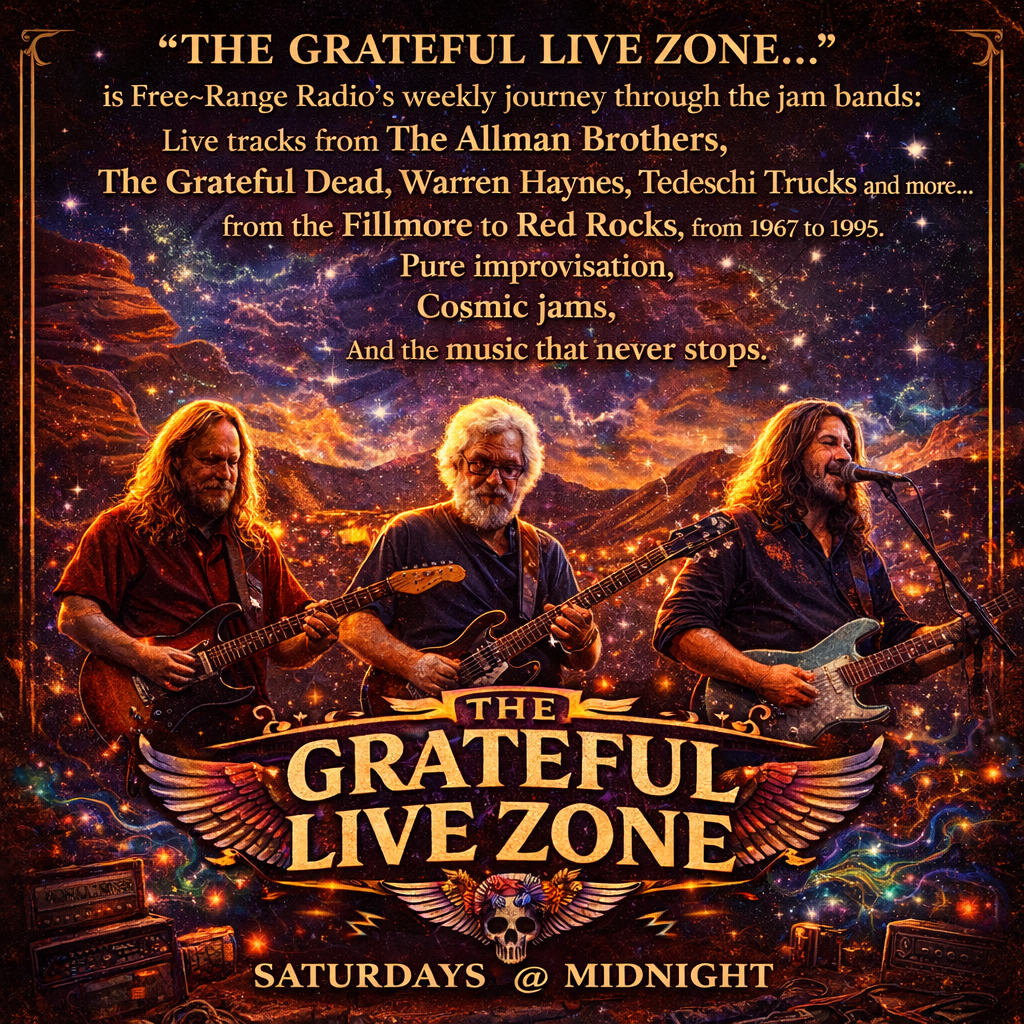
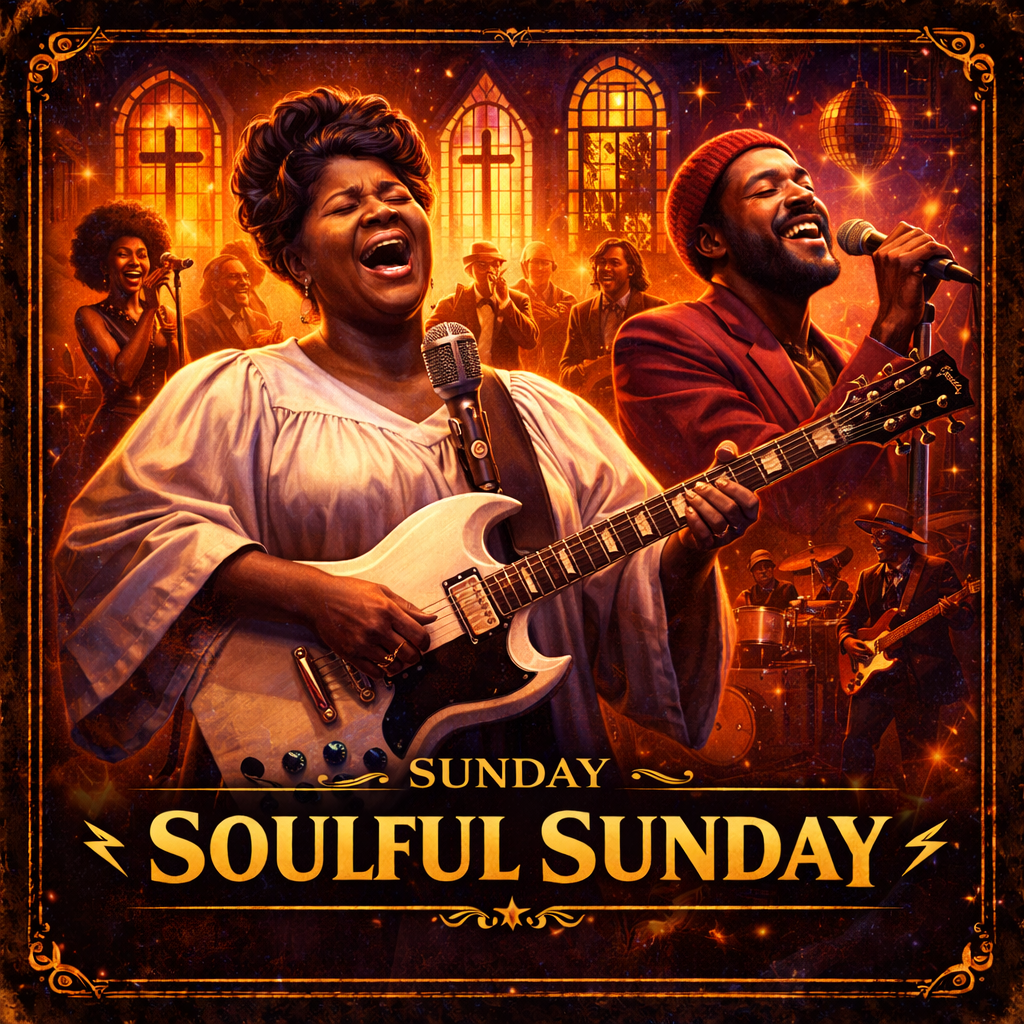
SUNDAY ~ SOULFUL SUNDAY
Where the Circle Closes and Begins Again
It is Sunday morning.
The week has been long and glorious and exhausting in the best possible way. Monday gave you the roots. Tuesday gave you the heartbreak. Wednesday gave you the revolution. Thursday gave you the guilty pleasures. Friday gave you everything simultaneously and then handed you over to the loudest midnight in radio history. Saturday took you on the longest psychedelic journey of the week through skiffle and Mersey beat and garage rock and San Francisco and Woodstock. And then Grateful~Live carried you through the midnight hours on the wings of the greatest live music ever recorded.
And now it is Sunday morning.
And something extraordinary happens on Sunday morning on Free~Range Radio.
The jams fade. The long tracks breathe their last note. The improvisation settles into silence. And from that silence — from the far end of the longest musical journey of the week — something rises up that sounds less like a radio station and more like a congregation finding its voice.
Because Sunday morning belongs to the music that started everything.
And the music that started everything was not rock and roll. It was not the blues. It was not country or folk or jazz or any of the genres that the week has traveled through.
It was gospel.
And gospel came from the church.
And the church came from a people who had nothing in the world except their faith and their voices and the absolute conviction that music was not entertainment but medicine. Not a product but a prayer. Not something you listened to but something you participated in with your whole body and your whole soul and every ounce of everything you had.
That is where Sunday begins.
That is where everything began.
THE ROOTS ~ SACRED MUSIC AND THE BIRTH OF EVERYTHING
To understand gospel you have to go back further than gospel. You have to go back to the fields.
African slaves brought to America carried their music with them. Not instruments — those were taken. Not written compositions — literacy was forbidden. But the music itself — the call and response, the rhythm, the communal participation, the understanding that music was not a spectator sport but a shared act — that survived the Middle Passage and the auction block and the cotton field and everything else that was done to destroy it.
The field holler. A single voice calling out across a field — sometimes a work song, sometimes a signal, sometimes pure expression with no words at all. Just sound. Just the human voice doing what the human voice does when words are not enough.
The ring shout. A communal ceremony where participants moved in a circle singing and clapping and stamping — not dancing in the European sense but moving in a way that was simultaneously musical and spiritual and deeply African in its roots. The ring shout survived slavery and reconstruction and the great migration and its DNA is present in every gospel service and every soul performance and every funk groove that came after it.
The spiritual. Songs that spoke of freedom in the language of scripture — Go Down Moses, Swing Low Sweet Chariot, Wade in the Water — songs that operated on two levels simultaneously. On the surface a religious text. Underneath a coded communication about escape and resistance and the possibility of a life beyond bondage. Follow the Drinking Gourd meant follow the Big Dipper north to freedom. The Jordan River meant the Ohio River — the border between slave states and free states. The music was doing double work. It was always doing double work.
And then after emancipation — after the Civil War and reconstruction — the music moved into the church. And the church transformed it into gospel.
GOSPEL ~ THE FIRE AT THE CENTER OF EVERYTHING
The African American church in the late nineteenth and early twentieth century was not merely a religious institution. It was the center of community life — the place where education happened and political organizing happened and cultural life happened and music happened on a level of intensity and sophistication that existed nowhere else in American life.
And the music that happened in those churches was extraordinary.
Thomas A. Dorsey is the father of gospel music as we know it. In the 1920s and 1930s Dorsey — who had previously played blues piano under the name Georgia Tom — began writing sacred songs in a style that combined the call and response of the spiritual with the blues feeling he had absorbed in the juke joints and the rhythmic energy of jazz. He was rejected by the church at first. The deacons didn't want the blues in the sanctuary. They didn't want that rhythm. They didn't want that feeling.
He persisted. And when his wife and newborn child died in childbirth in 1932 he sat down at the piano in his grief and wrote Precious Lord Take My Hand — one of the most beautiful songs ever written in the English language. Martin Luther King Jr. requested it at every major civil rights event. It was played at King's funeral. It transcended gospel and became a human document.
Mahalia Jackson found Dorsey's music and made it her own. Jackson was from New Orleans — born in the same city that gave the world jazz — and she carried that city's musical richness into everything she sang. Her voice was a force of nature. Not technically trained in the European sense but trained in something deeper — trained in the church, trained in the tradition, trained in the specific African American vocal aesthetic that prioritized feeling over precision and found that the two were not in conflict but were in fact the same thing.
Jackson refused to sing the blues commercially. She refused to cross over to secular music despite offers that would have made her wealthy. She sang gospel and only gospel — with a commitment and a power that made her the most important gospel singer of the twentieth century. When she sang nobody sat still. Nobody was unmoved. Her performances at the Newport Jazz Festival in the late 1950s converted people who had never set foot in a church in their lives.
Mahalia Jackson sang at the March on Washington in 1963. She was on stage when Martin Luther King Jr. was delivering his prepared remarks — remarks that were moving but not yet transcendent — and from the crowd she called out to him. Tell them about the dream Martin. Tell them about the dream.
And King put down his prepared text and began to speak from his heart.
And everything changed.
That is what gospel does. It unlocks something. It reaches past the prepared and the controlled and the careful and goes straight to the place where the truth lives.
Sister Rosetta Tharpe was a different kind of gospel singer entirely. She played electric guitar — and she played it with a fire and a technique that made men who considered themselves serious guitarists stop and stare. Chuck Berry watched Sister Rosetta Tharpe. Little Richard watched Sister Rosetta Tharpe. Elvis Presley watched Sister Rosetta Tharpe. She was playing rock and roll before rock and roll had a name. She was playing it in the context of gospel music. She was playing it with a Gibson SG and a Marshall stack and a stage presence so commanding that she made every male rock guitarist who came after her look like they were still learning.
She is the missing link. The woman who connected the church to the concert stage. The woman who proved that the sacred and the secular were not opposites but were the same fire burning in different rooms.
The Staple Singers. Pops Staples on guitar — influenced by the Mississippi Delta blues he had absorbed growing up, bringing that influence into gospel music in a way that deepened it. Mavis Staples singing — a voice of extraordinary power and warmth, capable of moving from a whisper to a full-throated declaration without losing a single ounce of feeling. Will the Circle Be Unbroken. This May Be the Last Time — which the Rolling Stones heard and turned into The Last Time. People Get Ready — which everyone from Bob Dylan to Rod Stewart to Aretha Franklin recorded because the song was simply too good to belong to any single artist.
THE GREAT CROSSING ~ WHEN GOSPEL BECAME SOUL
Here is the moment that changed everything.
In 1954 a young man from Albany Georgia named Ray Charles recorded a song called I Got a Woman. He took a gospel song — It Must Be Jesus by the Southern Tones — and replaced the sacred lyrics with secular ones. He kept the call and response structure. He kept the rhythmic intensity. He kept the feeling — the raw uninhibited emotional expression that gospel had developed over a century of church services.
He just changed what the feeling was about.
The church was scandalized. Gospel singers called it blasphemy. They called it sacrilege. They called Ray Charles the devil for taking the music of God and using it to sing about women and desire.
Ray Charles didn't care. Because what he had discovered was not blasphemy. It was the truth that Sister Rosetta Tharpe had already intuited — that the sacred and the secular were the same fire. That the voice that could bring a congregation to its feet in church could bring an audience to its feet in a nightclub. That the music was the music regardless of the words.
Ray Charles invented soul music in that moment. Not alone — never alone, music is never one person — but that recording is the crack in the dam through which everything flowed.
What is soul music? Soul music is gospel music that left the church and went out into the world. It carried everything gospel carried — the call and response, the rhythmic intensity, the emotional directness, the communal participation, the absolute refusal to be dishonest about what it feels like to be human — and applied all of it to the full range of human experience. Not just the sacred. All of it.
Sam Cooke was the most beautiful voice of the era. Trained in gospel — he had been the lead singer of the Soul Stirrers, one of the great gospel quartets — he crossed over to secular music in 1957 with You Send Me and became one of the biggest pop stars in America. But Cooke was not simply a pop star. He was a businessman — one of the first Black artists to own his own publishing and his own record label — and a political thinker whose A Change Is Gonna Come recorded in 1964 is one of the great documents of the civil rights era. A song of such quiet dignity and such profound sadness and such absolute conviction that a better world was possible that it remains devastating fifty years after his death.
Cooke was shot and killed in December 1964 at thirty-three years old. The world lost more than a singer that night. It lost a vision.
MOTOWN ~ THE SOUND OF YOUNG AMERICA
In Detroit Michigan in 1959 a young songwriter named Berry Gordy borrowed eight hundred dollars from his family and started a record label in a small house on West Grand Boulevard. He called the label Motown — a contraction of Motor Town, Detroit's nickname.
What came out of that house over the next decade was one of the most extraordinary concentrations of musical talent and commercial vision in American history.
Gordy understood something that the music industry had not yet fully grasped — that Black music could be marketed to white America if it was presented with sophistication and style and a production quality that the industry associated only with mainstream pop. He hired in-house songwriters — Holland-Dozier-Holland, Smokey Robinson, Norman Whitfield — who produced songs with a melodic and emotional perfection that transcended race and genre and demographic.
He hired in-house session musicians — the Funk Brothers, working in the basement of Hitsville USA — who developed a sound that was simultaneously gospel-rooted and pop-friendly. James Jamerson's bass playing — the most influential bass playing in the history of popular music, the foundation upon which virtually every subsequent pop record was built — combining gospel rhythm and jazz harmony and a melodic invention that turned the bass from a timekeeper into a voice.
The artists Gordy signed were trained not just musically but in deportment and presentation and how to conduct themselves in a white America that was still largely hostile. They were taught to move gracefully and speak gracefully and represent the label with dignity at all times.
And then they went on stage and sang.
The Supremes. Diana Ross's voice — cool and precise and emotionally controlled — fronting a trio whose choreography was as precise as their harmonies. Where Did Our Love Go. Baby Love. Stop in the Name of Love. You Can't Hurry Love. Come See About Me. A string of number one singles so consistent that it seemed less like artistic creation and more like manufacturing — and Gordy would have taken that as a compliment.
The Temptations. Five men — David Ruffin, Eddie Kendricks, Paul Williams, Melvin Franklin, Otis Williams — whose vocal blend and whose choreography set a standard that every subsequent vocal group measured themselves against. My Girl. Ain't Too Proud to Beg. I Can't Get Next to You. Then Norman Whitfield took them into psychedelic soul — Cloud Nine, Papa Was a Rolling Stone, Runaway Child Running Wild — music that was simultaneously commercial and experimental and political in ways that Gordy was not always comfortable with.
Marvin Gaye. The most complicated and most gifted artist in Motown's history. Sexual Healing. Let's Get It On. But also — and more importantly — What's Going On. Recorded in 1971 over Gordy's objections — Gordy thought it was uncommercial and too political — What's Going On is one of the greatest albums in American music history. A suite of songs about the Vietnam War and urban poverty and environmental destruction and spiritual crisis that is simultaneously a political document and a work of art and a prayer. Gaye recorded it as a complete album — not a collection of singles but a unified statement that had to be heard from beginning to end. It transformed what soul music could say and how it could say it.
Stevie Wonder. Who had been at Motown since he was eleven years old — Little Stevie Wonder, the twelve-year-old genius — and who in the early 1970s renegotiated his contract to gain complete artistic control and then produced in five years a run of albums — Music of My Mind, Talking Book, Innervisions, Fulfillingness' First Finale, Songs in the Key of Life — that is one of the most sustained periods of creative brilliance in the history of popular music. Playing virtually every instrument himself. Writing every song. Producing every record. Creating music of such melodic beauty and rhythmic sophistication and lyrical intelligence that it defied category.
Superstition. Living for the City. Higher Ground. Sir Duke. Isn't She Lovely. As. These are not soul songs or pop songs or funk songs or gospel songs. They are simply great songs — the work of a musician who heard all of those things simultaneously and refused to choose between them.
STAX AND THE SOUTHERN SOUL ~ THE OTHER SOUND
While Motown was creating its polished Detroit sound another kind of soul music was developing four hundred miles south in Memphis Tennessee.
Stax Records. Founded in a converted movie theater — the Soulsville label, the house that built Southern soul. Where Motown was smooth and orchestrated and carefully produced Stax was raw and immediate and rough around the edges in ways that made it feel more honest than anything coming out of Detroit.
The house band at Stax was Booker T. and the MGs — four musicians, two Black and two white, playing together in Memphis Tennessee in the early 1960s at a time when that was genuinely dangerous and genuinely radical. Booker T. Jones on organ. Steve Cropper on guitar — the most economical and the most perfectly placed guitar playing in soul music history, every note in the right place, never a note wasted. Donald Duck Dunn on bass. Al Jackson Jr. on drums — the most precise and the most soulful drummer in Memphis, the timekeeper who gave the music its heartbeat.
Otis Redding was the greatest soul singer of the 1960s. Not the most technically perfect — that distinction belongs to Sam Cooke. Not the most innovative — that belongs to Ray Charles. But the most purely and completely soulful — the singer who took the gospel intensity and the blues feeling and the full force of his enormous personality and channeled them into performances of such raw emotional power that they are almost physically overwhelming fifty years later.
Try a Little Tenderness. I've Been Loving You Too Long. Respect — which he wrote and recorded and which Aretha Franklin then took and transformed into something even larger than what he had created. Sittin' On the Dock of the Bay — recorded three days before his death, the first posthumous number one single in history. A song so simple and so perfect that it sounds like it had always existed and someone just finally wrote it down.
Redding died in a plane crash in December 1967 at twenty-six years old.
Wilson Pickett. The Wicked Pickett — a nickname earned. Mustang Sally. In the Midnight Hour — co-written with Steve Cropper, the song that defined the Stax sound. Land of 1000 Dances. A voice of such raw power and such physical intensity that his recordings sound like they are about to break free of the speakers.
Sam and Dave. Soul Man — a song so purely and perfectly constructed that it has served as the definition of soul music for every writer and musician who has attempted to explain what soul music is since 1967. Hold On I'm Comin'. When Something Is Wrong With My Baby.
Carla Thomas. Rufus Thomas. Isaac Hayes — whose Hot Buttered Soul in 1969 transformed what a soul album could be, with extended orchestrated arrangements and spoken word interludes that pointed toward hip hop. Shaft in 1971 creating the template for blaxploitation film music.
ARETHA ~ THE QUEEN
There is one name that stands above all others in the history of soul music.
Aretha Franklin.
The daughter of the Reverend C.L. Franklin — one of the most celebrated Baptist preachers in America, a man whose sermons were so powerful they were sold as records. Aretha grew up in the church. She was playing piano and singing in her father's church in Detroit by the time she was a teenager. Ray Charles heard her and said that she was the one person who made him nervous.
She recorded for Columbia Records through the early 1960s — years that produced competent pop records and nothing more, records that failed to capture what everyone who saw her live knew she was capable of.
Then in 1967 she signed with Atlantic Records and producer Jerry Wexler took her to Muscle Shoals Alabama to record. And everything changed.
Wexler understood something that Columbia had missed entirely. Aretha Franklin was not a pop singer who needed to be shaped and directed and produced into something commercially viable. Aretha Franklin was a force of nature who needed only to be pointed at a microphone and set free.
I Never Loved a Man the Way I Love You. Recorded in one session. One of the greatest recordings in the history of American music. A performance of such raw emotional power and such technical mastery that the musicians in the studio stopped playing at moments to listen to her sing.
Respect. Chain of Fools. (You Make Me Feel Like) A Natural Woman. Think. Spanish Harlem. You're All I Need to Get By. A string of recordings over the next four years that represents the greatest sustained period of vocal achievement in the history of soul music.
But Aretha was more than a soul singer. She was a political figure — a voice of the civil rights movement, a friend and supporter of Martin Luther King Jr., an artist who understood that her music was not separate from the struggle but was part of it. Think — recorded in 1968 in the week that King was assassinated — is not merely a song about a romantic relationship. It is a demand for freedom. It is a declaration of independence. It is gospel applied to the political moment with a directness and a power that no other artist could have achieved.
In 1972 Aretha returned to the church. Amazing Grace — recorded live over two nights at the New Temple Missionary Baptist Church in Los Angeles with the Southern California Community Choir and James Cleveland — is the best-selling gospel album in history. A two-hour return to the music she had grown up with. A reminder that everything she had done in soul music was rooted in this. That the river always flows back to its source.
FUNK ~ WHEN THE GROOVE BECAME THE POINT
And then James Brown changed everything again.
James Brown had been building toward funk since the early 1960s — each record getting more rhythmically complex, more percussive, more focused on the groove rather than the melody. Out of Sight in 1964. Papa's Got a Brand New Bag in 1965. I Feel Good. Cold Sweat in 1967 — the moment when rhythm became the entire point. A song where the melody was almost irrelevant because the groove was so deep and so complete that nothing else was needed.
James Brown invented funk. Not by designing it but by following his instincts to their logical conclusion — stripping the music down to its rhythmic core, making every instrument a percussion instrument, treating the human voice as another rhythm element. The one. The downbeat. The hit on the first beat of every measure that gave funk its physical punch.
Sly and the Family Stone took funk and added psychedelia and social consciousness and racial integration — Black and white musicians, male and female musicians, playing together with a joyful energy that felt like a statement about what America could be at its best. Dance to the Music. Everyday People. I Want to Take You Higher. Stand. There's a Riot Goin' On — the dark counterpart, the album that captured the disillusionment of the early 1970s when the dreams of the 1960s had curdled into something more complicated.
Parliament-Funkadelic. George Clinton creating an entire mythological universe — the Mothership, Dr. Funkenstein, the Clone of Dr. Funkenstein, Starchild — around music of extraordinary rhythmic sophistication and total conceptual abandon. Tear the Roof Off the Sucker. Flash Light. One Nation Under a Groove. Bernie Worrell's keyboards. Bootsy Collins' bass — the most flamboyant and the most musically sophisticated bass player in funk history. Eddie Hazel's guitar — his solo on Maggot Brain, recorded in one take with Clinton telling him to play as if he had just been told his mother had died, is one of the great guitar performances in rock history.
Bootsy Collins. Fred Wesley. Maceo Parker. The musicians who moved between James Brown's band and Parliament-Funkadelic creating a cross-pollination of rhythmic ideas that shaped the entire subsequent history of Black music.
The Meters from New Orleans. Art Neville and Leo Nocentelli and George Porter Jr. and Joseph Modeliste creating a funk so deep and so subtle and so rooted in the specific rhythmic DNA of New Orleans that it influenced every musician who heard it. Cissy Strut. Look-Ka Py Py. The meters were the house band of New Orleans funk — the musicians behind dozens of recordings by other artists — and their influence on hip hop through sampling has been immeasurable.
THE CONNECTION ~ HOW THE JAMS LED BACK TO THE ROOTS
Here is the thread that nobody talks about enough.
The Grateful Dead loved gospel music. Jerry Garcia listened to gospel. Phil Lesh studied the bass lines of gospel and soul and carried that influence into his playing. Mickey Hart was a scholar of world music who understood that the rhythms of West Africa — the same rhythms that had been carried to America in the slave ships and that had evolved into gospel and soul and funk — were the rhythmic foundation of the Dead's most extended improvisations.
Dark Star at its deepest — the moments when the music dropped to almost nothing and then rebuilt itself from a single note — was doing exactly what a gospel preacher does. Building. Reaching. Calling and receiving response. Creating a communal experience of transcendence through music.
The Allman Brothers understood this connection explicitly. Duane Allman had grown up listening to gospel and soul and R&B in the South — the same South that produced gospel, the same churches, the same musical tradition. His slide guitar playing owed as much to the gospel steel guitar players he had heard in church as to the blues musicians he had studied. In Memory of Elizabeth Reed at the Fillmore East is a jazz-influenced instrumental that swells and breathes and builds to moments of collective transcendence that are indistinguishable from what happens in a great gospel service.
Phish understood it too. Trey Anastasio's guitar playing at its most extended — following a melodic thread through a long improvisation, losing it, finding it again, sharing it with his bandmates, building it into something that the whole band and the whole audience arrived at together — was doing what the ring shout did. Creating a communal musical experience that transcended the individual. Putting the audience inside the music rather than outside it.
And the audiences at jam band concerts — the Deadheads, the Phishheads, the fans of Widespread Panic and Gov't Mule and Tedeschi Trucks — they understood this too, even if they didn't have the vocabulary for it. They came back night after night and show after show because the music was doing something that ordinary rock concerts didn't do. It was creating community. It was creating shared transcendence. It was doing what the church had always done.
The groove always leads back to the source.
The improvisation always finds its way home.
SUNDAY MORNING ~ THE RETURN
And so, on Sunday morning on Free~Range Radio the Grateful~Live tracks fade. The long jams breathe their last note. The improvisation settles into silence.
And from that silence — from the far end of the longest musical journey of the week — the music returns to where it began.
A piano. A voice. A chord that opens like a door.
And Sunday becomes what Sunday was always meant to be.
The gospel hour. Not a museum piece. Not a nostalgic recreation. But the living tradition — from the field hollers and the spirituals through Mahalia Jackson and Thomas Dorsey through Sister Rosetta Tharpe and the Staple Singers through Ray Charles crossing the line between sacred and secular through Aretha returning to Amazing Grace through the tradition that never died and never will.
The R&B that grew from gospel. The soul that carried gospel's fire into the secular world. The funk that took gospel's rhythm and made it the whole point. The neo-soul of the 1990s — D'Angelo and Erykah Badu and Maxwell and Lauryn Hill — bringing everything back to the voice and the feeling and the truth that gospel had always known.
Mahalia Jackson singing How I Got Over.
Sam Cooke singing A Change Is Gonna Come.
Aretha Franklin singing Amazing Grace.
The Staple Singers singing I'll Take You There — which is not a gospel song and is also entirely a gospel song, a funk groove with a message of deliverance that Mavis Staples delivers with the authority of someone who knows exactly where she is taking you.
Al Green. Whose voice is the most sensual and the most spiritual in soul music simultaneously — a combination that seemed paradoxical until you understood that the sacred and the secular were always the same fire burning in different rooms. Take Me to the River. Let's Stay Together. How Can You Mend a Broken Heart. And then Green became a reverend — literally ordained, literally leading a congregation in Memphis — and the music became explicitly gospel again and lost nothing in the transition.
Curtis Mayfield. Whose falsetto voice and whose guitar playing and whose songwriting combined political urgency and spiritual depth in a way that made every song a sermon and every sermon a song. People Get Ready — covered by everyone, owned by no one, belonging to the tradition. Move On Up. Superfly. Keep On Pushing. A man who spent his entire career insisting that music was not separate from justice. That the groove and the message were the same thing.
THE FULL CIRCLE
Here is the truth that Sunday reveals.
The blues that Free~Range Radio played on Monday morning — the music of Robert Johnson and Muddy Waters and Howlin' Wolf — came from the same place as the gospel that plays on Sunday morning. They were born in the same churches and the same fields and the same communities. They separated — the sacred and the secular going their different ways — and then spent the entire century finding each other again in soul and R&B and funk and rock and all the forms the music took as it traveled.
The country music of Tuesday came from the same Scots-Irish and Appalachian tradition that shaped the white gospel and shape-note singing of the American South — music built on the same harmonic principles, the same call and response, the same conviction that a song could carry more than entertainment.
The punk and new wave of Wednesday carried gospel's energy — the urgency, the rawness, the refusal to be polite about what it felt like to be alive — into a completely different context. The Clash's political conviction was a secular gospel. Patti Smith's performances were rituals as much as concerts.
The progressive rock of Friday morning was reaching for the same transcendence that gospel had always known how to create — trying to get music to do what music does in a great church service, trying to take the listener somewhere they could not go in ordinary life.
And the jam bands — the Dead and the Allmans and Phish and all the inheritors of that tradition — were doing explicitly what gospel had always done implicitly. Creating communal transcendence through shared musical experience. Putting the congregation inside the music.
It all comes from the same place.
It all goes back to the same place.
The voice raised in joy or anguish or both simultaneously. The rhythm that the body cannot resist. The melody that reaches somewhere deeper than intellect and touches something that has no name but that everyone who has ever been moved by music knows exactly what it is.
That is gospel.
That is soul.
That is what Sunday is.
That is what Free~Range Radio is.
One hundred years of music. Seven days of discovery. And on the seventh day the music returns to its source — to the voice and the rhythm and the feeling that started everything — and in returning reveals that the source was never far away. That it was present in every genre and every song and every moment of the entire week.
The circle closes on Sunday morning.
And on Monday morning it opens again.
Free~Range Radio ~ Beyond Sonic Borders 1-877-33VINYL
🎙️✨